Those who don’t have it want it, and those who have it will do whatever they can to keep it. I’m talking about the ever-illuminating perceived value of a strong brand.
Your brand is an intangible asset.
And this intangible asset exists in the hearts and minds of your customers. That means, unlike physical products or services, we can’t quickly calculate the financial return of this so-called intangible asset on our bottom line.
This matters because, if you’re surrounded by short-term thinking or a performance-heavy team, investing in initiatives solely to “build up your brand” may fly under the radar in favour of marketing endeavours that are easier to quantify or sell to executives (read: they have a clear way to calculate ROAS).
Why invest in it?
How your brand is perceived by the world is more valuable to your firm’s bottom line than you may think. When it comes to communicating this value, I like to refer to the perceived value framework.
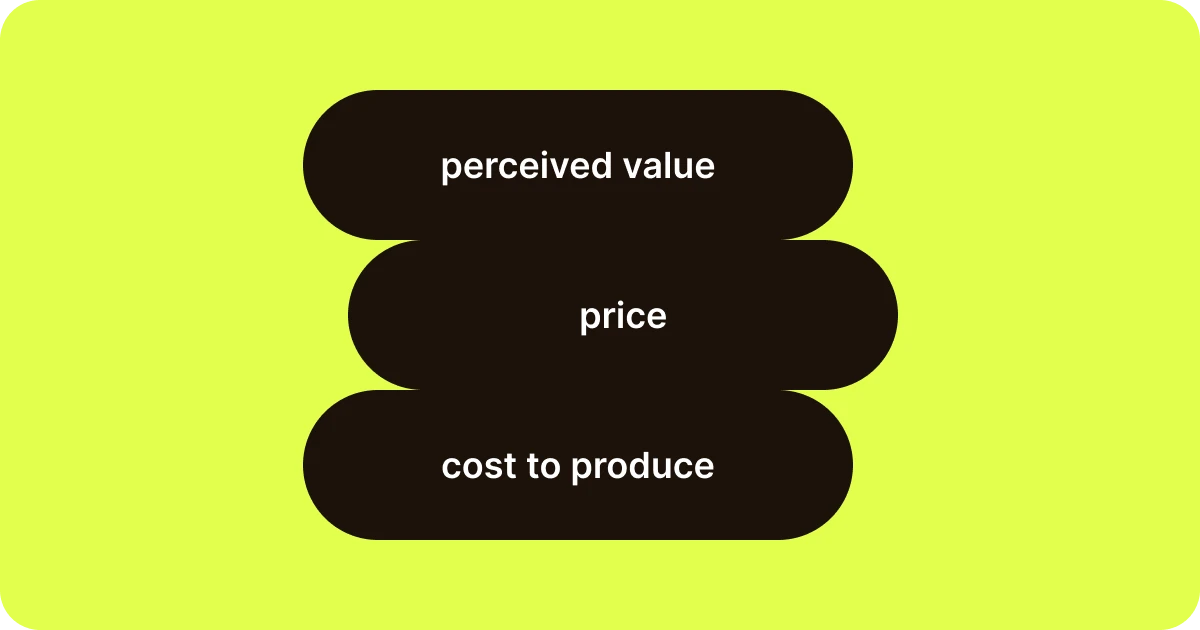
The framework consists of three lines, and depending on your strategy, these lines can shift upward or downward:
- Cost to produce – how much it costs your firm in materials and human power to create the good or service (COGS).
- Price – how much you charge the market for that good or service.
- Perceived value – how much the market is willing to pay.
Raising your perceived value.
Enhancing perceived value is what brand building is all about. Yet it’s arguably the trickiest part of brand-building because, for the most part, perception rests in the hands of your buyers.
From quality cues to Maslow-style elements of value, there are many schools of thought on the “how” of building perceived value (something I’ll likely dive into in the future). But for now, let’s focus on what happens once you’ve successfully moved that perceived value line upward.
Once your perceived value rises, your firm faces two choices: keep your price point the same or raise your price to meet the new perceived value.
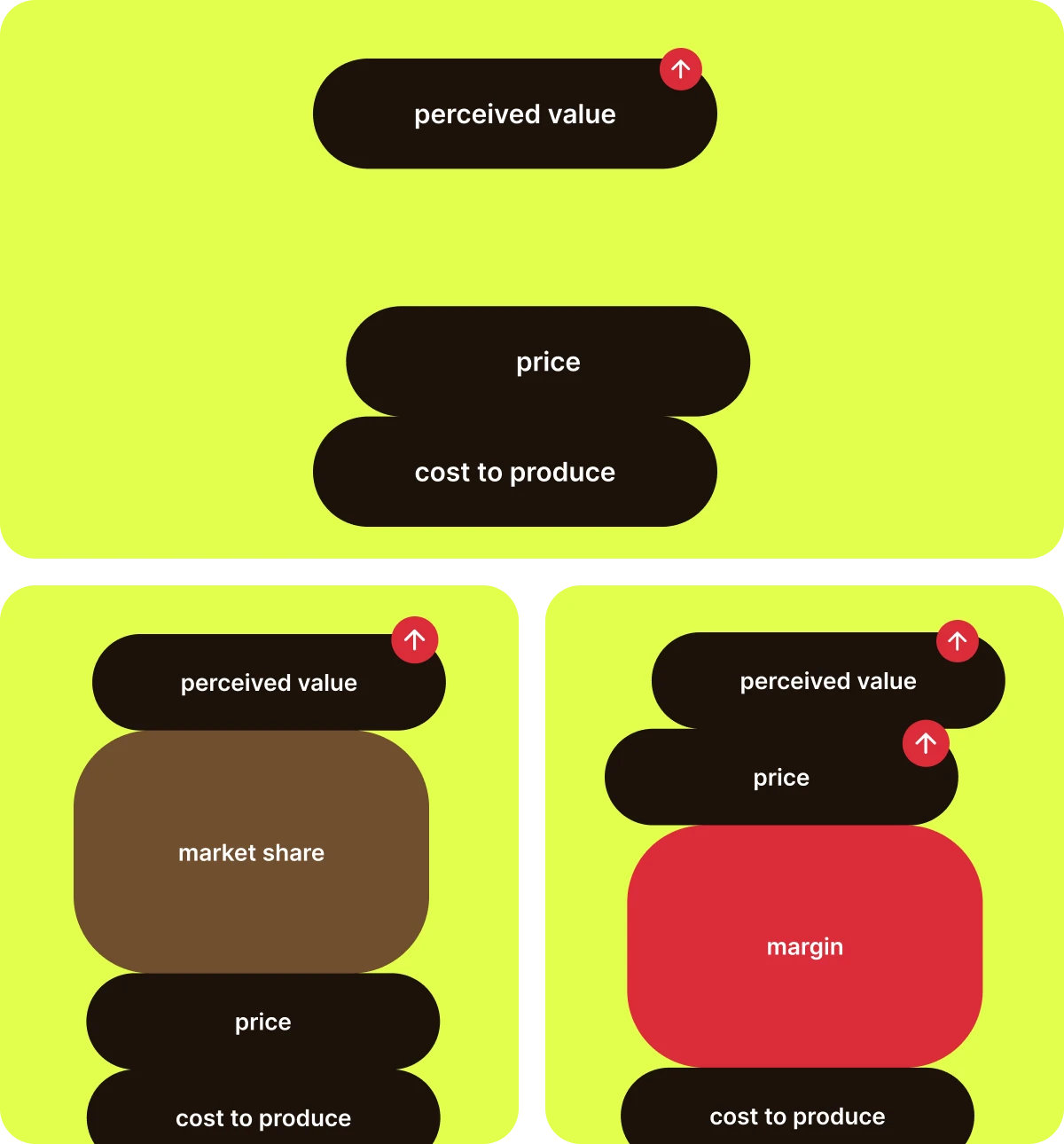
As the image above depicts, raising perceived value while keeping the price point the same theoretically results in your firm capturing a larger share of the market. Presumably, more people are interested in your product or service because its perceived value has risen, and, with the price staying constant, more buyers participate.
Think of the Stanley Cup portable mug craze. With the help of influencers and social, the perceived value of Stanley cups skyrocketed. Suddenly, hoisting a Stanley around meant that you were a hydrated girly “in the know” (social cohesion at its finest). Since its price point remained fairly steady, Stanley drastically expanded its share of the drinkware market in just a few years. And, the payoff was huge: annual sales jumped from $75 million to $750 million. Many agree that without the CEO’s strategic investments in social, a deliberate play to raise perceived value in the digital ecosystem, we wouldn’t be having this conversation.
Now, let’s examine what happens when you raise your price point to meet your new perceived value line. In this second scenario, instead of capturing more of the market, you’re effectively trading volume for margin (fewer buyers, but higher profit per unit).
A classic example here is the luxury car market. A more timely case may be the cosmetic brand Glossier. Riding a wave of cult-like popularity, they raised prices multiple times on flagship products, with Boy Brow going from £14 to £22 in under four years (a 57% increase, according to one “flabbergasted” Redditor). Many customers in that same Reddit thread discussed being “priced out” and opting for cheaper dupes. Still, it was only because of the rise in perceived value that Glossier was able to push through those price hikes in the first place.
Conclusion
In my opinion, investing in initiatives that improve the perceived value of your brand is rarely wasted effort. It gives you flexibility: expand market share while holding prices steady, or improve unit margins if you decide to increase prices. The biggest hurdle here lies in doing it right, setting aside the annual budget and establishing internal benchmarks to measure perception shifts.
Sources, further reading, etc.
Section School’s Brand Strategy Sprint taught by Scott Galloway.
Stanley Cup Craze Floods TikTok Feeds, Raises $750 Million In Revenue, 2024. Forbes.
How a 40-Ounce Cup Turned Stanley Into a $750 Million a Year Business, 2023. CNBC.
YETI is the Drinkware Giant, but Stanley is Catching Up Fast, 2024. CBInsights.
How Glossier Turned Itself Into a Billion-Dollar Beauty Brand, 2020. WIRED.
Makeover: Building a Billion-Dollar Beauty Brand in the Influencer Era, 2023. New Yorker.